

Computer Based Training in Aviation: Europe’s Digital Training Revolution
The way Europe trains its pilots, cabin crew, and maintenance engineers is undergoing the most significant transformation in decades. Driven by regulatory reform, a structural pilot shortage, and the rapid maturation of digital learning technology, computer based training (CBT) in aviation has moved from a supplementary tool to a central pillar of how approved training organisations across Europe design and deliver their curricula.
In 2024, the global safety eLearning market for airlines was valued at $2.48 billion — and it is projected to nearly double, reaching $5.43 billion by 2033, growing at a compound annual rate of 8.9%. Europe is at the heart of this shift, driven by EASA regulatory momentum, a multilingual workforce that demands flexible training delivery, and airlines and ATOs that are under real pressure to train more people, faster, without compromising safety.
This guide explains what aviation CBT is, how it fits within the European regulatory framework, what it covers, and why the flight schools and airlines that adopt it strategically are building a measurable competitive advantage.
What Is Computer Based Training in Aviation?
Computer based training in aviation refers to the delivery of educational content through digital platforms — using software, interactive multimedia, animated system diagrams, scenario-based modules, and online assessments — to train aviation professionals across all disciplines.
The term is used broadly across the industry, sometimes interchangeably with eLearning, distance learning, or online ground school. In practice, CBT encompasses a spectrum of formats. At its most basic, it involves self-directed digital modules that replace printed study materials. At its most sophisticated, it integrates adaptive learning algorithms, gamified assessments, 3D interactive aircraft system visualisations, and Learning Management Systems (LMS) that automatically track regulatory compliance for every user.
Aviation CBT is used across every professional category in the industry:
- Pilots — for ATPL theoretical knowledge, type rating ground school, recurrent training, and dangerous goods
- Cabin crew — for safety procedures, CRM, first aid, and dangerous goods
- Maintenance engineers — for Part-66 knowledge subjects, type training, and human factors
- Air traffic controllers — for initial licensing, unit endorsements, and recurrent competency training
The defining characteristic is flexibility: content is accessible at any time, on any device, from any location. For aviation professionals who operate across shift patterns, irregular schedules, and multiple international bases, this is not simply a convenience — it is a fundamental enabler of continuous learning.
The European Regulatory Landscape for Aviation CBT
Europe has been progressively building the regulatory infrastructure for digital and competency-based training over the past decade — and the pace is accelerating.
EASA and the European Commission have established CBT as a legitimate and, in some areas, preferred method of training delivery across multiple regulatory frameworks. The key milestones:
- 2016: EASA incorporated Evidence-Based Training (EBT) principles into its regulatory framework for pilots, endorsing outcome-focused training methods that align directly with CBT delivery.
- 2020: The European Commission officially adopted baseline EBT requirements, integrating them into the regulatory standard for recurrent training.
- 2022: EASA issued a dedicated Competency-Based Training and Assessment (CBTA) Rulemaking, further embedding CBT-compatible frameworks across pilot licensing and training.
- October 2025: The European Commission adopted Implementing Regulation (EU) 2025/2143, which formally introduces CBTA and virtual training methods for air traffic controllers across Europe. Member states have until 1 January 2029 to update their training methodologies accordingly.
This regulatory direction sends a clear signal to every ATO, airline, and training provider operating in Europe: digital training is not a workaround or a shortcut — it is increasingly the standard. Organisations that have not yet built their CBT capability face a compliance transition that only becomes more demanding over time.
For ATPL theory specifically, EASA already recognises distance learning as a valid method for delivering a significant proportion of the 14-subject ground school curriculum. Many European ATOs now offer blended programmes in which up to 90% of theoretical content is delivered through CBT platforms, with supervised sessions and mock exams completing the programme.
What CBT Covers: From ATPL Theory to Recurrent Training
Modern aviation CBT platforms are not limited to a narrow slice of the curriculum. The scope of subjects that can be effectively delivered through digital training is extensive.
Initial and Theoretical Training
For pilot candidates, CBT is widely used across all 14 ATPL theoretical knowledge subjects recognised by EASA:
- Air Law and ATC Procedures
- Aircraft General Knowledge (airframes, systems, powerplant, electrics)
- Flight Performance and Planning
- Human Performance and Limitations
- Meteorology
- Navigation (General Navigation and Radio Navigation)
- Operational Procedures
- Principles of Flight
- Communications (VFR and IFR)
- Mass and Balance
- Flight Planning and Monitoring
Well-designed CBT modules for these subjects use animated diagrams, interactive quizzes, embedded practice questions, and progress dashboards — delivering content in a format that consistently produces better retention outcomes than passive classroom lectures.
Recurrent and Compliance Training
For qualified aviation professionals, CBT has become the dominant delivery channel for mandatory recurrent training. Modules routinely delivered via CBT in European airline and ATO environments include Dangerous Goods (updated annually per IATA DGR), Crew Resource Management (CRM), Fatigue Risk Management (FRM), RVSM, ETOPS, Safety Management Systems, Low Visibility Operations, TCAS procedures, Cold and Hot Weather Operations, security awareness, and emergency procedures refreshers.
When regulatory content changes — new EASA amendments, updated ICAO standards, revised operator procedures — a CBT module can be updated once and immediately deployed to thousands of users, with no scheduling overhead and instant compliance tracking.
CBT vs. Classroom Training: A Practical Comparison
The debate between classroom and digital training has largely resolved in favour of blended approaches — but understanding the specific trade-offs helps training managers make smarter deployment decisions.
What CBT Does Better
Knowledge retention. Traditional lecturing produces an average retention rate of just 5%. By contrast, discussion-based and interactive learning methods achieve retention rates of 50% or more. Well-designed CBT uses active recall, embedded quizzing, and scenario-based exercises that push learning retention far beyond passive lecture attendance.
Cost efficiency. The four-week ground school component of a type rating programme, delivered traditionally, is one of the most expensive phases in pilot training — requiring dedicated classrooms, pulled-off-line instructors, and accommodation for relocating students. A European airline that integrated VR-enhanced digital training reported a 30% reduction in training time, directly lowering the cost per trained pilot.
Consistency and scalability. Every student receives identical content at the same quality level, regardless of which instructor delivered the live session. For airlines training hundreds of crew across multiple bases, CBT removes the variability that inevitably enters large-scale classroom delivery.
Compliance management. An LMS automatically records every module completed, every score achieved, and every certificate generated. For EASA compliance audits, this creates an instantly retrievable, timestamped training record — far more reliable than paper logs.
Flexibility. Aviation professionals with irregular rosters or international bases can fit CBT around their schedules without missing training windows or triggering regulatory currency lapses.
What Classroom Training Still Does Better
CBT is not a complete replacement for all aviation training. The ability to ask questions, receive immediate feedback, and work through complex material with an experienced instructor remains most valuable when students are processing genuinely new and difficult content for the first time.
The most effective European ATOs combine both: CBT for content delivery and knowledge building, live instruction for reinforcement, scenario analysis, and examination preparation. This blended model captures the efficiency of digital delivery while preserving the pedagogical depth of instructor-led sessions.
The Role of AI, VR, and Adaptive Learning in Modern Aviation CBT
The aviation CBT landscape in Europe is not static. At EATS 2025 — the European Aviation Training Summit, held in Cascais in November — AI, VR/XR, and data-driven training dominated virtually every conversation on the exhibition floor and in the conference streams.
Artificial Intelligence is being integrated into CBT platforms to deliver adaptive learning experiences. Rather than presenting all students with an identical module sequence, AI-enabled systems assess individual performance in real time and adjust content difficulty, pacing, and focus areas accordingly. CAE’s AI-driven Smart Training System, used by airlines including Lufthansa, monitors trainee responses during simulator sessions and adjusts scenarios dynamically based on demonstrated strengths and weaknesses.
Virtual Reality and XR are enabling a new category of CBT that goes beyond screen-based content into fully immersive procedural training. Lufthansa Aviation Training presented its D-CEET (Digital Cabin Emergency Evacuation Trainer) VR prototype at EATS 2025. In November 2025, Boeing launched its Virtual Airplane Procedures Trainer (VAPT) — powered by Microsoft Azure and Microsoft Flight Simulator — allowing pilots to practise procedures on a standard computer or iPad, initially for the Boeing 737 MAX.
Adaptive and gamified platforms are addressing one of the most persistent criticisms of early-generation CBT: that it was passive, repetitive, and disengaging. Modern platforms use badges, progress milestones, interactive branching scenarios, and competitive elements to drive engagement and completion rates.
According to IATA and CAE data, around 47% of operators and ATOs across aviation have already implemented CBTA practices, and 65% of those who have not yet done so plan to within the next three years. The European market shows sustained momentum, supported by EASA’s regulatory direction and carriers’ genuine need to train at scale.
CBTA and EBT: How CBT Connects to Competency-Based Frameworks
It is worth clarifying the relationship between CBT, CBTA, and EBT — terms that are often used in overlapping ways in European aviation training discussions.
CBT (Computer Based Training) refers to the delivery method — how training content reaches the learner. It is a channel, not a philosophy.
CBTA (Competency-Based Training and Assessment) refers to the pedagogical framework — an approach that focuses on demonstrating mastery of specific competencies rather than accumulating a fixed number of hours. CBTA defines what success looks like and how it is measured.
EBT (Evidence-Based Training) is an ICAO-derived framework for recurrent training, which uses operational data and incident analysis to design training scenarios that reflect real-world risks. EASA formalised EBT requirements for recurrent pilot training in 2020.
The connection is important: CBT is the most effective channel for delivering CBTA content. The modular, self-paced, assessment-integrated nature of digital platforms aligns naturally with competency-based frameworks, where learners advance by demonstrating mastery rather than completing fixed time blocks. Airbus incorporated CBTA into its A350 Type Rating as early as 2014, and has since extended it to the A320 Family, A330, A220, Ab Initio, and Command and Recurrent training courses.
How Leading European ATOs Are Implementing CBT
Across Europe, the pattern of CBT adoption at Approved Training Organisations is converging on a blended model that is becoming the operational standard.
The most sophisticated implementations share several characteristics. First, a robust LMS infrastructure — capable of managing course libraries, user permissions, completion tracking, and regulatory reporting simultaneously. Second, content designed to EASA and ICAO standards — not simply digitised PDFs, but purpose-built interactive modules with embedded assessments, updated in sync with regulatory changes. Third, device agnosticism — content accessible from desktops, laptops, tablets, and smartphones, supporting the varied environments of aviation professionals.
The adoption rate is notably higher among pilot training organisations for initial ATPL training, where the volume of theoretical knowledge — 14 subjects, hundreds of hours of study — makes CBT the only practical delivery method at scale. For recurrent training in airline operations, the business case is even clearer: airlines cannot pull operational crew from the line for week-long ground schools when a well-designed CBT module achieves the same regulatory outcome in a fraction of the time.
The safety eLearning market for airlines in Europe is growing at a steady 8.3% CAGR, reflecting sustained investment by carriers who view digital training as a strategic infrastructure decision that simultaneously improves compliance management, training consistency, and crew availability.
CBT at ERAH Aviation Academy
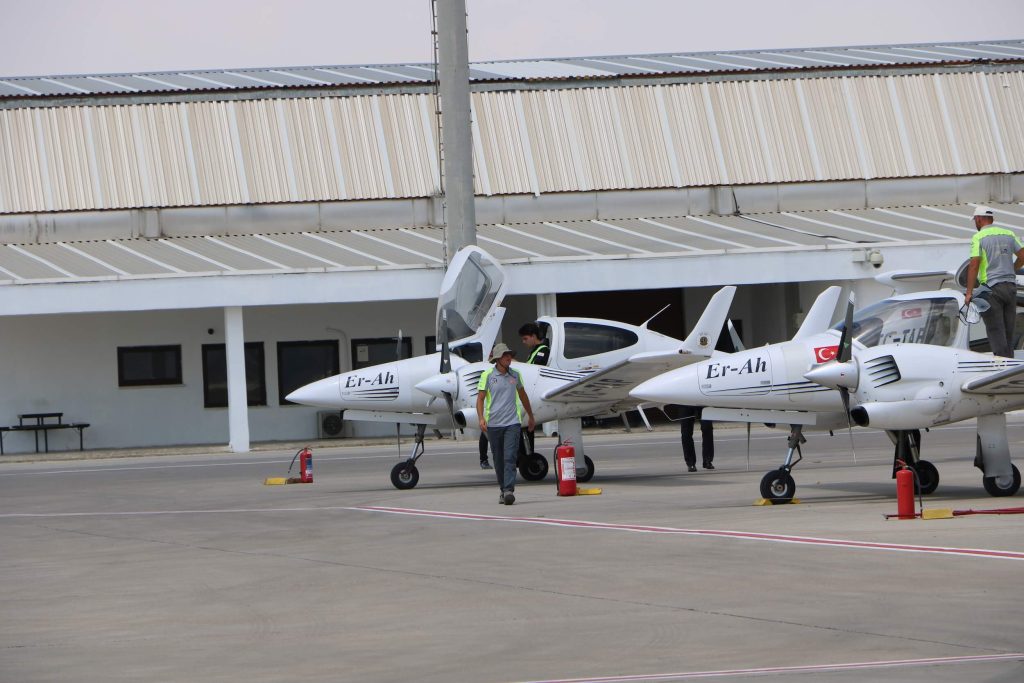
ERAH Aviation Academy, based at Isparta Süleyman Demirel Airport in Turkey, has built one of the most digitally accessible ATPL training environments in the region — and its programmes are directly available to European students through its Integrated and Modular ATPL pathways.
In ERAH’s Modular ATPL programme, up to 90% of theoretical content can be completed online through a flexible, device-compatible CBT platform that includes iPad-compatible e-books and interactive digital modules. This enables students who cannot relocate full-time to complete the substantial theoretical knowledge phase of their ATPL remotely, maintaining full SHGM compliance throughout.
ERAH’s ground school faculty includes airline captains and TRI/TREs who bridge the gap between digital content and real-world application — ensuring that students arrive at the simulator and flight line with knowledge that is genuinely embedded, not merely clicked through.
For European students evaluating ATPL programmes, ERAH’s combination of EASA-standard training quality, exceptional flying conditions (340 VFR days per year at Isparta), modern simulator infrastructure, and a digital learning platform that genuinely supports flexible theoretical study represents a compelling and well-rounded training environment.
To learn more about ERAH’s integrated and modular ATPL programmes and CBT delivery, visit erah.aero.
Frequently Asked Questions
What is computer based training (CBT) in aviation?
CBT in aviation refers to the use of digital software, interactive multimedia, and online platforms to deliver theoretical and procedural training to pilots, cabin crew, air traffic controllers, and maintenance engineers. It replaces or supplements traditional classroom instruction, offering flexible, self-paced access to regulatory-compliant content from any device.
Is CBT accepted by EASA for aviation training in Europe?
Yes. EASA supports CBT across multiple regulatory frameworks. EU Regulation 2025/2143, adopted in October 2025, formally introduced CBTA and virtual training for air traffic controllers, with member state compliance required by January 2029. Distance learning is also recognised for a significant proportion of ATPL theoretical knowledge delivery.
What subjects can be covered by CBT in aviation?
CBT covers all 14 ATPL theoretical knowledge subjects, dangerous goods, CRM, RVSM, ETOPS, safety management, TCAS, aircraft systems, weather operations, and recurrent compliance modules. Both initial and recurrent training can be fully or partially delivered through CBT depending on the regulatory category and ATO approval.
What are the main advantages of CBT over classroom training in aviation?
The primary advantages are self-paced learning, 24/7 accessibility from any device, consistent content quality, automatic LMS-driven compliance tracking, rapid deployment of regulatory updates, multilingual delivery, and significant cost savings — eliminating the travel, accommodation, and scheduling overhead of traditional classroom courses.
Does ERAH Aviation Academy use computer based training in its programmes?
Yes. ERAH integrates CBT into its ATPL programmes, with up to 90% of theoretical content in the Modular ATPL programme accessible online via iPad-compatible e-books and interactive digital modules — making it one of the most accessible pilot training programmes in the region for students combining studies with other commitments.
Conclusion: The Digital Training Advantage
Computer based training in aviation is not a trend on the horizon — it is the operating standard that Europe’s most effective ATOs, airlines, and training organisations have already adopted. Driven by EASA’s strengthening regulatory framework, the structural demand for trained aviation professionals, and the proven effectiveness of well-designed digital learning, CBT has earned its place at the centre of how Europe trains its aviation workforce.
The organisations that will gain the most from this shift are those that move beyond compliance-minimum digital training and invest in genuinely engaging, EASA-aligned CBT platforms that treat learners as professionals, not checkbox completers. The data is clear: interactive, competency-focused digital training produces better-retained knowledge, more compliant records, and more operationally capable graduates than passive classroom delivery.
For student pilots beginning their ATPL journey, understanding how to evaluate an ATO’s CBT infrastructure is now as relevant as evaluating its fleet and simulator quality. The best training environments integrate all three — and forward-thinking institutions like ERAH Aviation Academy are already there.